What Google I/O 2026 actually changed, and why we've been refreshing the announcement page all morning
If you only skimmed the headlines from Google I/O 2026, you saw two announcements about Android tooling. AI Studio can now build native Android apps from start to finish. Firebase is shipping something called Agent Skills on GitHub. Most coverage filed both under "more AI stuff in dev tools" and moved on.
We think that framing misses what actually happened.
Google didn't ship features this week. They unbundled an assumption. The assumption that mobile development and testing has to live inside somebody else's cloud. The device-fragmentation and toolchain-complexity tax that built an entire category of vendors (device clouds, mobile CI platforms, test orchestration suites) just had its first serious structural challenge.
This is the post we wished someone had written for us on day one. Less recap, more architecture. We'll dig into why the mobile testing stack ended up looking the way it did, what changed at the primitive level, which assumptions break, and where the ecosystem actually shifts.
Why mobile testing got centralised in the first place
To see why this week matters, you have to remember why the device-cloud economy showed up at all.
Mobile testing got hard for reasons that desktop and web testing never had to think about.
- Device fragmentation. "Android" is a category, not a target. The top 100 devices in any given market span four years of OS versions, six chipset families, three different display aspect ratios, and a long tail of OEM skins that change how UI behaves in production. A test that passes on a Pixel 8 might fail on a Xiaomi mid-tier because the manufacturer rewrote the WebView in their own way. You can't ignore this. You have to test against it.
- iOS provisioning. Apple's signing and provisioning model means that running tests against iOS at any scale needs real device infrastructure with proper Apple Developer credentials, certificate management, and physical device farms or simulators with serious compute behind them. There's no equivalent to "spin up a headless Chrome container."
- Sensor and hardware access. A meaningful chunk of mobile bugs only show up when the app has access to a real GPS chip, a real accelerometer, a real camera, a real Bluetooth stack. Emulators get you maybe 70% of the way there. The remaining 30% is where production crashes live.
- Network condition realism. Apps behave very differently on a stable 5G connection in San Francisco than on a flaky 3G in São Paulo. Simulating that needs either sophisticated cloud-side network shaping, or actual devices in actual regions on actual carriers.
- CI compute economics. Running parallel mobile tests at scale eats CI minutes like nothing else. A single full-matrix run can take hours on a self-hosted setup. Most teams just outsourced this rather than build it.
The combination produced an entire industry. BrowserStack, Sauce Labs, LambdaTest, Kobiton, HeadSpin, Perfecto. The pitch was always some version of "don't build your own device farm. We already have 10,000 real devices. Here's an API. You're welcome."
That pitch was correct. It's still correct for the use cases it was designed for. But it produced a structural assumption (mobile testing needs our cloud) that has now started cracking at the bottom.
What ADB-in-AI-Studio actually changes
The technical surface of the AI Studio announcement is narrower than the marketing made it sound. It is not "Google replaced device clouds." It's more interesting than that.
Google AI Studio is a browser-hosted environment. What's new is that it now bundles an integrated Android Debug Bridge transport. Meaning, a browser session can, via a USB-connected developer device on the user's machine, push a generated APK to that device and install it. The agent that built the app can then drive it.
If you've lived in mobile dev tooling, you immediately see what's interesting here. The standard developer loop has been:
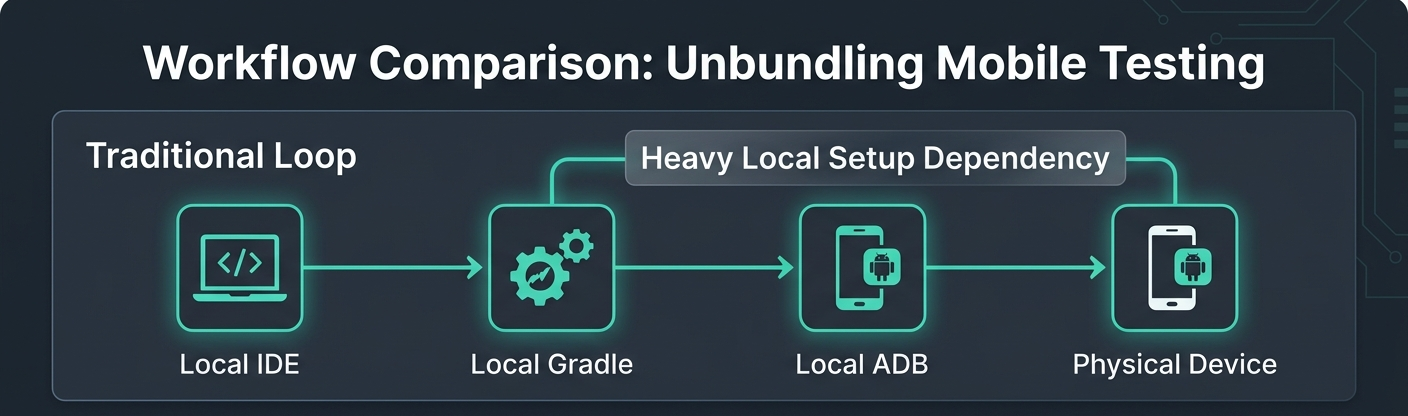
The path was short, but every node needed setup. You needed the IDE installed. You needed the SDK. You needed the right build-tools version. You needed adb in your path. You needed your device in developer mode with USB debugging on. For anyone past their first day of Android development this is muscle memory. For everyone before that day, it was the wall.
What changed:
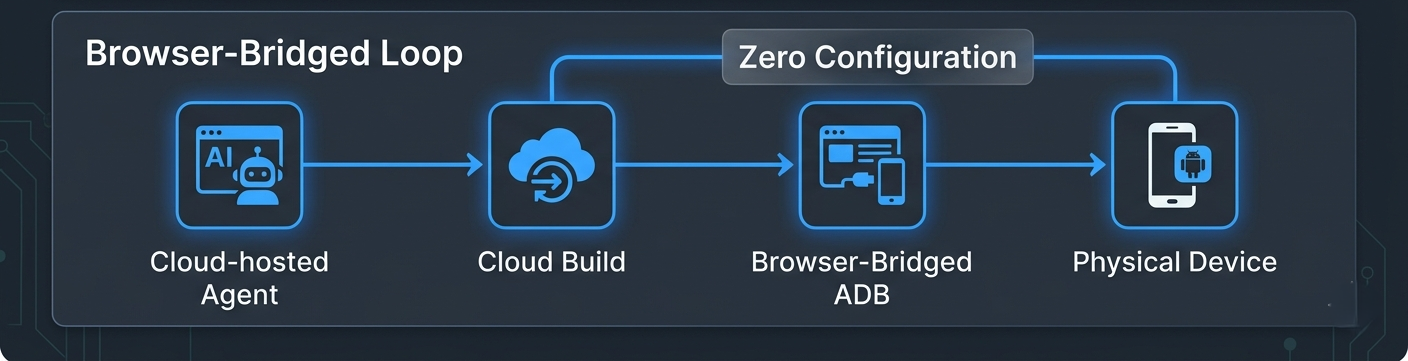
The local toolchain dependency collapses. The build happens server-side. The transport, which is the genuinely novel piece, is bridged through the browser to a device the user already owns. No SDK install. No Gradle setup. No JDK version war.
For testing, this changes one specific tier of the funnel. Single-device, real-hardware smoke testing during development. The class of "I just want to see this run on my actual phone before I push." That use case used to drive a developer to either set up local tooling, or pay for a single-device entry plan on a hosted service. Now it has a free, integrated path.
What it does not change:
- Cross-device matrix testing at scale (still needs cloud)
- Geographic distribution and real-network testing (still needs cloud)
- Parallel CI execution for large suites (still needs cloud)
- Compliance and security-controlled testing environments (still needs cloud)
- iOS, at all (Apple will not allow this kind of access)
The premium tier of the device-cloud business is fine. But the entry tier, which is the funnel that converts curious developers into paying enterprise customers over time, just got an alternative path. That matters more for the device-cloud businesses than the press releases will let on. The entry tier is where you build the developer relationship that you later monetize.
Agent Skills. The part most people are reading wrong.
Most of the coverage of Firebase Agent Skills has framed them as "Google's MCP." That's wrong, and the distinction matters.
Agent Skills and the Model Context Protocol are complementary, not competing. They solve different problems in the agent stack.
MCP is the where. It's a wire protocol that lets an agent connect to external systems. A database, a SaaS API, a file store. Through a standardized JSON-RPC interface. It defines how the agent reaches outside itself. Anthropic introduced it in late 2024 and the ecosystem has converged on it for tool integration.
Agent Skills are the how. They're packaged, portable instruction sets (typically a SKILL.md file plus optional helper scripts and references) that teach an agent the procedural knowledge for a domain. "How to debug a Firestore security rule." "How to interpret a Crashlytics issue group." "How to architect an offline-first Android data layer." Anthropic open-sourced the format late last year. Google is now publishing into the same standard.
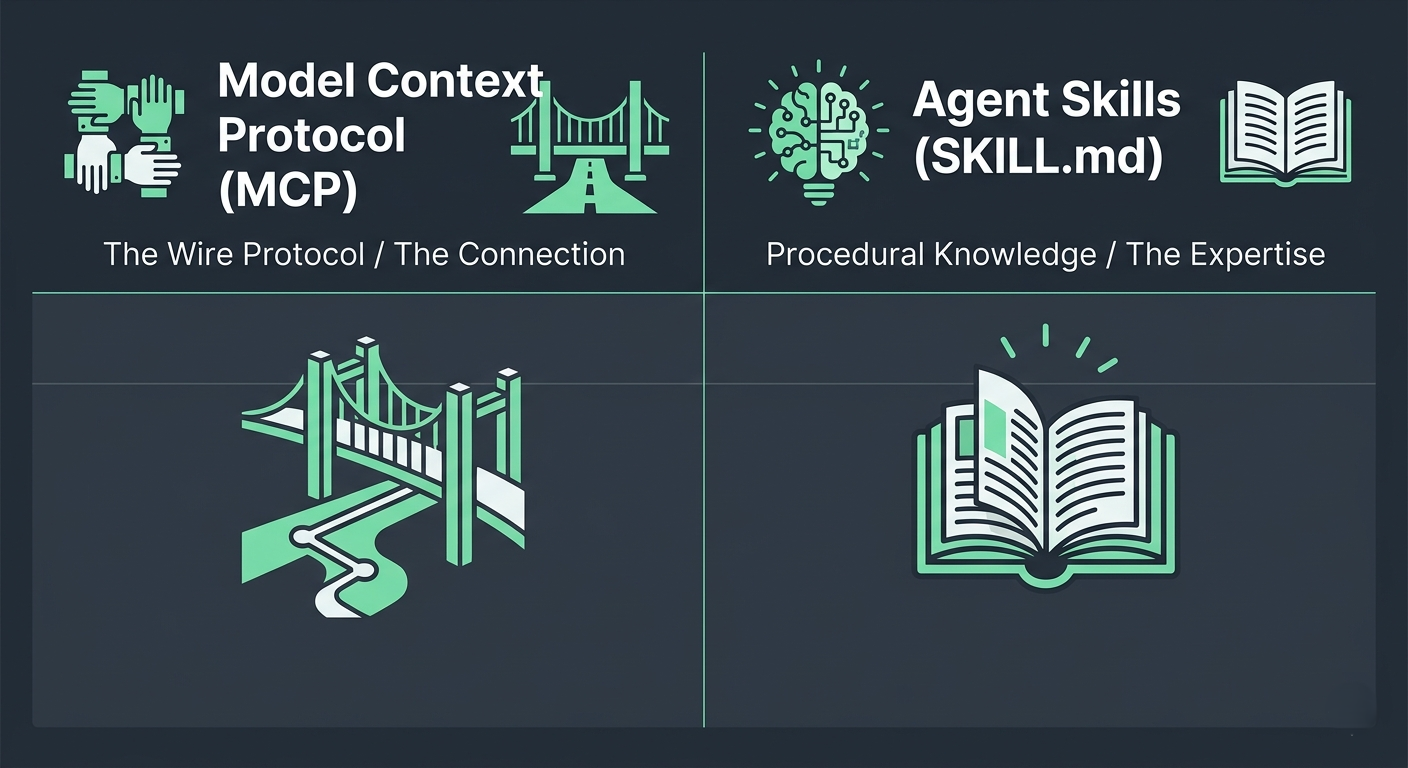
The simplest mental model we've found is this. MCP gives your agent hands. Skills give your agent expertise. You need both. An agent connected to Firebase via MCP but without Firebase domain knowledge will write bad code that happens to compile. An agent with deep Firebase skills but no MCP connection will write good code it can't actually run against your project.
What Google shipped this week is the expertise layer. The Firebase Agent Skills repository contains procedural knowledge, written in the open, portable, agent-agnostic skills format, for Firestore, Firebase Auth, Crashlytics, App Check, and the rest of the Firebase platform. They install into Claude Code. They install into OpenAI's Codex. They install into Cursor. They install into anything that implements the skills standard.
This is a meaningful posture from Google. The historical default for a platform vendor would have been to keep this kind of expertise locked inside a proprietary first-party agent (Gemini in Android Studio, Firebase Studio) and force you to use it to get the benefit. Instead, Google decided that more developers using Firebase from whatever agent they prefer beats fewer developers locked into Google's own agent. That's a long-game read on where the industry is going.
For mobile testing specifically, the relevant skills are the ones that ground an agent in Crashlytics and observability patterns. If your testing agent can install the Crashlytics skill, it now knows, without you having to teach it, how Crashlytics groups crashes, what a useful stack trace looks like, what breadcrumb context means, how to correlate a crash signature to a recent code change. That domain knowledge was previously something every QA tool vendor had to embed by hand. Now it's open source.
The closed loop, in concrete terms
When you combine these two announcements with the agent runtimes already in market, you get something that was a slide in someone's deck until this week. Now it's an architecture.
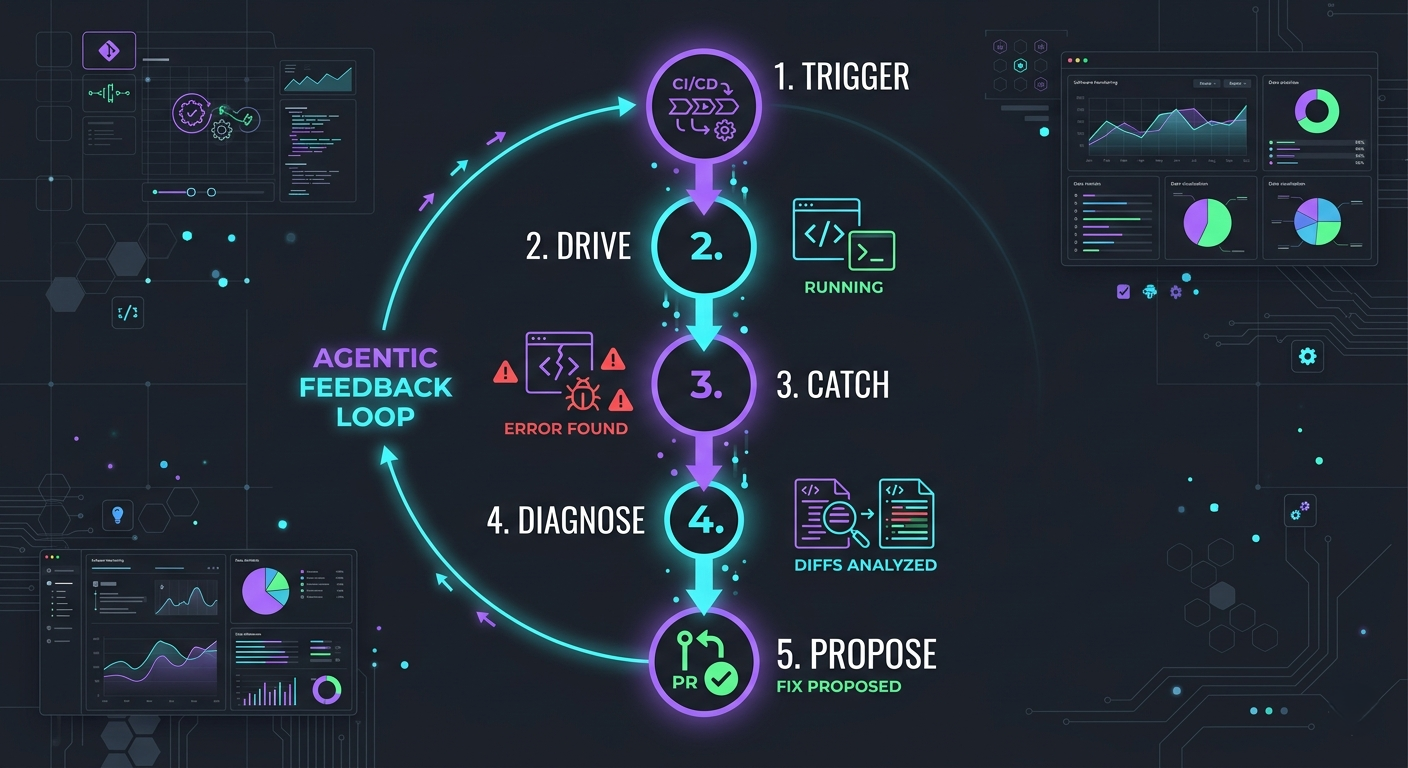
Let's walk through a realistic loop. You push a commit that introduces a regression in your checkout flow.
- Trigger. A scheduled run kicks off your agent. It builds the app, either locally via Gradle or remotely via the AI Studio build pipeline, and pushes it to a connected device via ADB. Until this week, that build-and-push primitive required local toolchain setup. Now it doesn't.
- Drive. The agent executes the test flow. This part isn't new. Several agent-native testing runtimes already do this competently. What's new is that the agent can read the flow from a portable skill ("how to test a checkout flow on Android") rather than from a hand-written script that breaks every time the UI shifts.
- Catch. The flow crashes. Crashlytics ingests the crash. Until this week, getting structured access to that crash from an agent meant writing custom integration code, dealing with the Crashlytics API quirks, and embedding the domain knowledge of how Crashlytics groups issues directly into your agent's prompt. With the Crashlytics agent skill installed, the agent already knows how to query the right issue group, pull the relevant stack frames, and read the breadcrumb context.
- Diagnose. The agent correlates the crash signature to your recent commits. That part is just code reading, which agents are already good at. It identifies the suspect change, reads the surrounding code, and forms a hypothesis. The Firebase Agent Skills give it grounding for the patterns it's looking at. The codebase access (via MCP or direct filesystem) gives it the actual material to reason over.
- Propose. It opens a PR with a fix and a written explanation. Then it re-runs the flow against the patched build. If green, it requests review. If red, it iterates.
Three of those steps (trigger, catch, diagnose) had a meaningful proprietary-glue dependency before this week. Now they have stable, open, documented primitives. The walls between "test runner," "observability tool," and "fix recommender" have started to come down because the protocol layer between them is now public.
The implication is the part that's hard to overstate. The testing pipeline can become a single agentic loop instead of a chain of products with humans gluing them together. That is a different category of thing than "AI inside the test runner."
How the ecosystem reshapes
Let's get specific about who this lands well for and who it lands badly for.
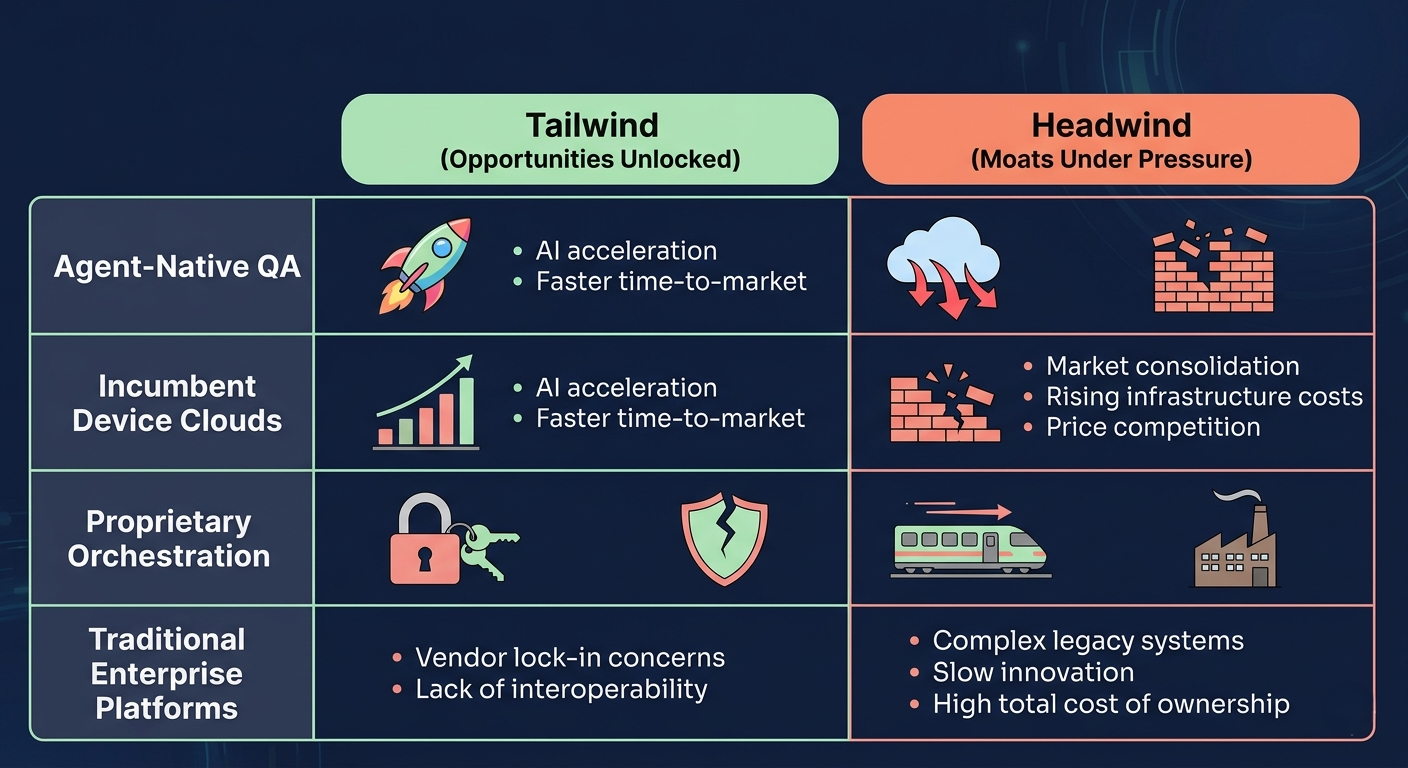
Tailwind for the agent-native testing thesis
The whole category of agent-first mobile QA. Testing platforms built around an AI agent that owns the full loop rather than a human stitching tools together. The category just got infrastructure tailwind. The hard parts of running that thesis were never the idea. They were the connective tissue. Getting builds onto real devices reliably. Grounding the agent in observability semantics. Keeping the loop portable across the customer's existing stack. Those three things just got materially easier for anyone serious about building in this category.
The substrate benefits too. Established test frameworks designed for programmatic consumption (Espresso, UI Automator, Appium, the newer YAML-flow runners) are well-positioned as the execution layer under agentic loops. The more open the surrounding ecosystem, the more they're worth.
Headwind for entry-tier device clouds
BrowserStack, Sauce Labs, LambdaTest, Kobiton, HeadSpin. The device-cloud incumbents face a real but specific challenge. Their premium business (large device matrices, geo-distributed real devices, network condition simulation, enterprise compliance) is unaffected. Their entry tier, where solo developers and small teams adopt the platform for single-device smoke testing before growing into paid plans, is the funnel under pressure. Funnels matter. Most of these businesses were built on land-and-expand motions. The land just got harder.
Headwind for proprietary orchestration plumbing
Vendors whose differentiation is closed orchestration logic (the glue that connects the test runner to the device farm to the bug tracker to the dashboard) are in a tougher spot. If the primitives for each of those steps are now open and the protocol between them is becoming standardized, the moat erodes. Value moves up the stack to the diagnostic and remediation layer.
Mixed signal for traditional enterprise test platforms
Tricentis, Perfecto, Eggplant, and similar enterprise-suite vendors live in a world where the buyer is procurement and the seller is account executives. They'll be slower to feel this. But the next-generation buyer who comes up testing on the new stack will not naturally arrive at their procurement table.
What Google did not fix
Intellectual honesty is useful here. A few things this week's announcements did not change.
- iOS is still iOS. Apple controls provisioning, signing, and device access in ways that prevent this kind of unbundling on their platform. Real-device iOS testing remains a centralized-cloud problem for the foreseeable future. Anyone painting this as the end of mobile device clouds is hand-waving iOS.
- Cross-device matrix testing still needs a cloud. You can't smoke-test against the long tail of OEM Android devices from a single USB-connected Pixel. The "I just need to run it on my phone" tier is genuinely democratized. The "I need to know it works on a Vivo running MIUI in Indonesia" tier is not.
- Real-world conditions still need infrastructure. Network shaping, location spoofing at scale, battery and thermal condition simulation. None of these are solved by ADB-over-USB.
- The hard ML problems are still hard. Catching the crash is easy. Reading the right code to understand why it happened, distinguishing a symptom from a cause, proposing a fix that doesn't break three other tests. Those are still hard agent problems. The agent skill format makes it easier to package domain knowledge, but the underlying reasoning still has to be good.
- Test data and test environment management. Realistic test data, ephemeral environments, seed and cleanup flows. None of this got easier this week.
What got easier this week is the connective tissue. The hard parts are still hard. But they were always going to be hard. What was changing too slowly was the plumbing around them, and that's what just unlocked.
Why Google is doing this
A short note on intent, because it matters for what comes next.
Google has a defensive interest and an offensive interest here. Both point the same direction.
Defensive. The agentic IDE wave (Cursor, Claude Code, Codex, Windsurf, and the rest) is largely platform-agnostic. Developers are increasingly choosing tools based on agent quality rather than platform allegiance. That's a problem for Google specifically, because Android-the-platform has historically benefited from Android-the-tooling being the default path. If a developer can build a great Android app from any agent, that benefit breaks. Publishing high-quality Firebase and Android skills in the open format is how you make sure those agents produce Google-platform-native output rather than generic cross-platform output.
Offensive. Firebase wants to be the default backend for vibe-coded apps. The path to that is making Firebase the easiest backend to wire up from any agent, which you achieve by publishing the skills, integrating with AI Studio, and shipping the connective tissue. The play is to win the AI-built-app backend layer the way they won the mobile backend layer in the 2010s. The strategy is open-by-default because closed-by-default loses to whoever goes open first.
Both reads point to the same prediction. Google will keep investing in open primitives for the agent stack, especially where those primitives keep Google services central. Expect more skills. Expect deeper AI Studio integrations with the open ecosystem. Expect the next round of announcements to push further down this path.
Where QApilot sits
So, finally, why this matters for us specifically. Because we've been building toward it for a while.
The QApilot thesis from day one has been that the highest-leverage place to apply AI in mobile QA is not inside a test runner. It's around the test runner, owning the whole loop. The pattern we kept seeing was teams running expensive, slow QA cycles where the test execution layer was already fine. The bottleneck was everywhere else. Figuring out what to test as the app changed. Generating and maintaining flows that didn't flake every release. Triaging crashes when they happened. Proposing fixes instead of just filing tickets. Those are agent problems, not runner problems.
So we built around that. QApilot's architecture is an agent that owns the full test → execute → diagnose → propose fix → re-verify loop, with the test runner as one component inside it rather than the center of gravity. That bet shaped what we had to build. And what we had to build a lot of was connective tissue. How the agent reaches real devices. How it reads crash data in a structured way. How it stays grounded in Android-specific patterns rather than producing generic, plausible-looking code that doesn't actually work on real handsets. How it stays portable across customer environments without becoming a snowflake per deployment.
Three of those problems just got significantly easier this week.
- Device access primitive. ADB-from-AI-Studio normalizes the "build → install → drive" path that previously needed us to maintain customer-side toolchain glue. We don't have to be the people who teach every customer how to wire
adbinto their CI in week one anymore. - Crashlytics grounding. The Firebase Agent Skills do, in the open, the kind of domain-grounding work we were going to have to keep doing privately. Our agent (and yours, if you build one) now has authoritative Google-published instructions for how to interrogate a crash, how to read Crashlytics' grouping logic, how to correlate breadcrumbs to symptoms. That's higher-quality grounding than anything any third party was going to write.
- Portability. Agent Skills are an open format. The work we do to extend or compose them stays portable across agent runtimes. We're not betting our customers' workflows on one closed ecosystem.
| What Google Just Democratized (The Orchestration Plumbing) | What QApilot Solves Autonomously (The High-Leverage Logic Loop) |
|---|---|
| Browser-to-Device Transport: Piping a server-side build over a bridged USB connection without local SDKs, Gradle wars, or local environment dependencies. | Autonomous App Exploration: Intelligently crawling, driving, and mapping complex native app layouts without relying on brittle, hand-written test scripts. |
| Open-Source Crash Semantics: Public, standardized blueprints defining how Crashlytics groups issue signatures and structures stack traces. | Root-Cause Analysis & Self-Repair: Correlating that crash back to the exact Git filesystem diff, isolating the breaking change, and authoring the actual remediation PR. |
Portable Skills Specification: The open SKILL.md format for packaging platform instruction sets uniformly across external agent runtimes. |
Dynamic Matrix Upkeep: Ensuring the entire feedback loop adapts elastically as the UI morphs, eliminating the manual maintenance tax of QA suites. |
Full-loop agentic mobile QA was the plan before I/O and is the plan after. It changes how fast we can get there, and how much of our engineering time goes into the diagnostic-quality and self-repair work that's actually the high-leverage part.
The other thing worth saying out loud. This announcement materially expanded our market. AI Studio just lowered the floor on who can ship a real Android app. The next wave of Android apps will be built by people who never set up a local toolchain, never opened Android Studio, and never wrote a line of Kotlin by hand. Those apps will still crash. They will crash more, in interesting and novel ways, because they're being built by people who don't yet have the production-hardened instincts. They'll need QA. Their builders will not want to learn Espresso. The natural fit for that customer is an agent that handles testing the same way the rest of their workflow gets handled. Autonomously, in natural language, with the loop closed. That's the customer we built QApilot for.
So that's our read on this week. The architectural floor under us rose. The market above us got bigger. And the alternative that everyone defaults to (pay a device cloud, hire a QA contractor, build internal tooling) got harder to justify for the kind of teams now shipping apps. We're all over it. Concrete platform updates coming in the next few weeks.
If you're building a mobile app and the testing story is something you've been putting off because the existing options didn't fit how your team actually works, get in touch. This is the right moment to have that conversation.
References
- Build native Android apps in Google AI Studio, Android Developers Blog
- Firebase Agent Skills, GitHub
- What's new from Firebase at Google I/O 2026, Firebase Blog
- Agent Skills specification, the open standard
- Model Context Protocol, Anthropic