What Your App Store Rating Is Actually Telling You About Your QA Process
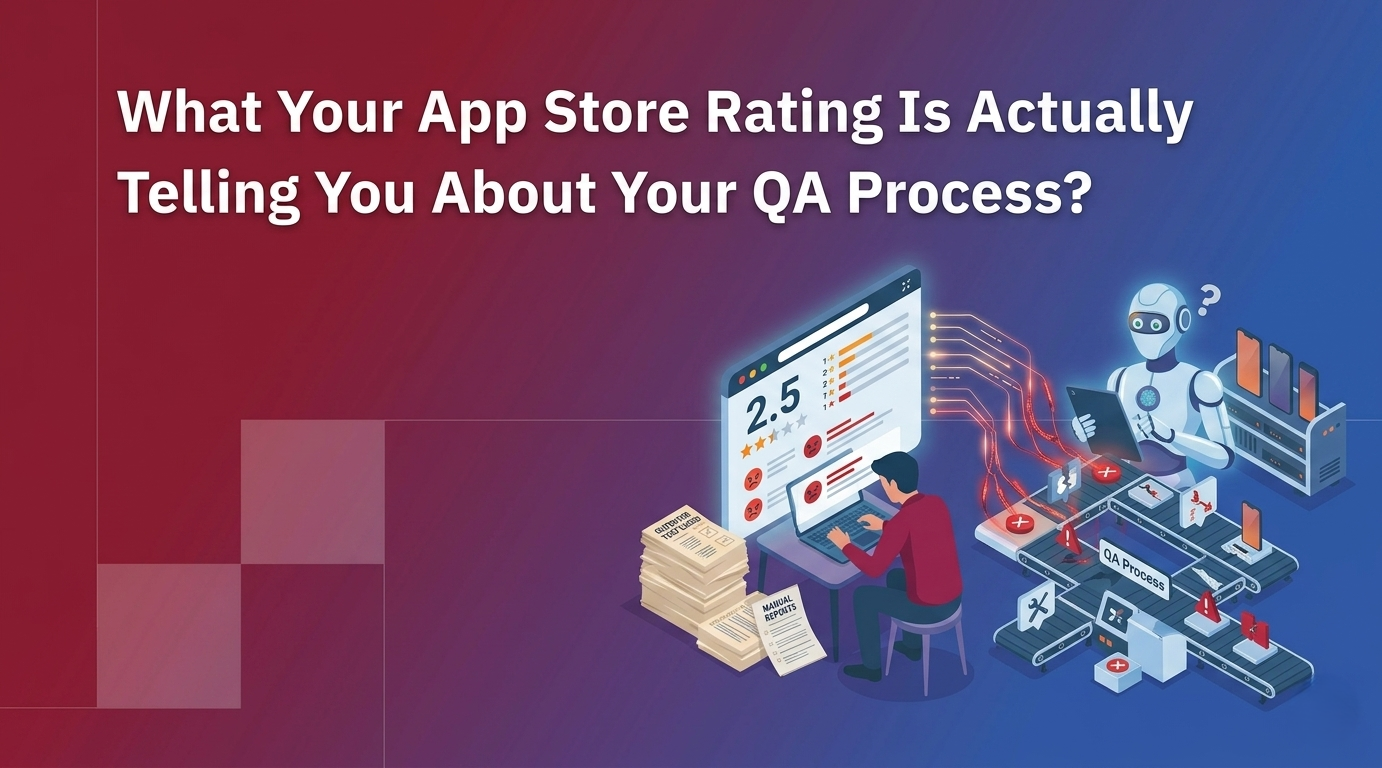
A 3.2-star rating isn't a marketing problem. It's a QA diagnosis.
Most mobile teams treat app store ratings as something the growth or ASO team manages — respond to reviews, prompt happy users, push the average up. But if you look at what users are actually writing in those one and two-star reviews, the pattern is almost always the same: the app crashed during checkout, the login screen froze, a button stopped working after an update. These aren't perception issues. They're quality escapes — bugs that made it through your test process and landed on a real user's device.
Your app store rating is the most public, unfiltered signal you have about where your QA process is breaking down. The question is whether you know how to read it.
The Rating Is a Lagging Indicator — But It's Pointing at Something Real
By the time a rating drops, the damage is already done. A user hit a bug, lost trust, left a review, and probably uninstalled. You didn't catch it in staging. You didn't catch it in your CI pipeline. You didn't catch it in your test suite. It shipped.
The correlation between app stability and store ratings is well established. Low crash-free session rates reliably predict low ratings. Apps rated above 4.5 stars see significantly higher install conversion than lower-rated peers. On Google Play, Android Vitals directly ties your app's stability metrics to its store visibility — consistent instability can suppress your ranking algorithmically, before users even get a chance to write a review.
So the rating is lagging, but it's not lying. It's telling you that something upstream in your quality process has a gap.
What the Reviews Are Actually Saying
Break down a batch of one and two-star reviews for almost any mobile app and you'll find they cluster into a few categories:
Crashes and freezes. The app stopped working at a critical moment — during a transaction, mid-session, on a specific device or OS version. This is a stability failure. It means the affected flow wasn't tested on that device configuration before release, or wasn't tested under real-world conditions at all.
Regression bugs. "It worked fine before the last update." A feature that used to work broke silently in a new release. This is a regression coverage problem — your test suite isn't catching what breaks when you ship new code.
Device-specific issues. The bug only appears on certain screen sizes, manufacturers, or OS versions. This is a device matrix problem. If your test runs are limited to a narrow set of devices, you're effectively blind to a large portion of your real user base.
Flow breakdowns. The app works in isolation but fails during a multi-step journey — signup to onboarding to first use, for example. Individual screens test fine. The end-to-end path doesn't. This is a coverage architecture problem.
Each category maps directly to a gap in your QA process. The review is the symptom. The gap is the cause.
The QA Process Patterns That Produce Bad Ratings
Testing too late. QA that happens at the end of a sprint, rather than integrated into the development cycle, means bugs are found when they're expensive to fix — or not found at all because the timeline pressure to ship is already high. By the time the bug makes it to the store, it's been baked in for weeks.
Narrow device coverage. Your team tests on the devices you have. Real users are on thousands of device-OS combinations. A bug that only manifests on Android 12 on a mid-range Samsung never gets caught in a lab running on three flagship phones.
Manual regression on every release. Manual testing is slow and doesn't scale with release frequency. Teams that release weekly or fortnightly but rely on manual regression end up either slipping coverage or slipping the release. Both paths lead to quality escapes.
Testing happy paths only. Most test suites validate that the app works when everything goes right. Users don't live in happy paths. They get interrupted, they switch apps mid-flow, they have slow connections, they tap things in unexpected orders. These edge cases are where bugs live — and they're exactly what structured automated coverage misses if the test scenarios weren't designed with real user behaviour in mind.
No visibility into what broke and why. If you can't trace a production bug back to the build, the commit, or the test run that should have caught it, you can't fix the process. You can fix the bug, but the same gap will produce a different bug next release.
What a QA Process That Protects Ratings Actually Looks Like
The common thread in teams that consistently maintain strong ratings is that they've shifted from reactive to systematic quality.
Automated coverage across the real user journey. Not just unit tests and API tests, but tests that validate actual app flows the way a user would experience them — navigating screens, completing tasks, recovering from interruptions. The goal is coverage of the paths that matter to users, not just the paths that are easy to test.
Real device testing at scale. Emulators catch some things. Real devices catch the rest. Testing across a meaningful device matrix — different manufacturers, OS versions, screen sizes — is the difference between finding a bug before your users do and finding it after.
Testing integrated into CI/CD. Every build should be validated before it ships. This means automated tests running in the pipeline, not as a gate that gets bypassed under deadline pressure, but as a normal part of how a build gets promoted. If a build breaks a critical flow, it shouldn't be releasable.
Shift from step-by-step checks to end-to-end validation. A test that checks whether each screen renders correctly tells you very little about whether the user can actually complete a task. End-to-end flow validation — does this entire sequence of actions work the way it's supposed to? — catches the class of bugs that per-screen checks miss entirely.
Closed-loop visibility. When something fails in production, you should be able to answer: which build introduced it? Which test should have caught it? Why didn't it? Without that traceability, you can't improve the process — you can only respond to symptoms.
The Rating You're Aiming For Is a Byproduct
Teams that obsess over the rating number tend to optimise for the wrong things — prompting reviews at moments of delight, filtering who gets asked, gaming the mechanics. These tactics move the number but they don't move the underlying quality.
Teams that obsess over the process — systematic coverage, real device validation, integrated automation, end-to-end flow testing — tend to find that the rating takes care of itself. Because the bugs that drive one-star reviews stop reaching users.
Your app store rating is a lagging indicator of decisions your team made weeks or months ago: what you chose to test, how thoroughly you tested it, and how quickly you caught what broke. It's one of the most honest pieces of feedback your QA process will ever receive.
The question is whether you're reading it as feedback — or just managing it as a metric.
QApilot is an AI-native mobile test automation platform built to give mobile teams systematic, end-to-end coverage without the overhead of manual scripting or maintenance. Learn more at qapilot.io.