
Joe Colantonio on Flutter Testing in 2026: Why Mobile Teams Need a New Playbook
Summarise with AI
Key takeaways
Joe Colantonio’s latest article on Flutter testing in 2026 explores why traditional automation is falling behind, and how mobile teams are shifting toward faster release readiness.
Charan Tej Kammara
Product Marketing Lead
Joe Colantonio on Flutter Testing in 2026: A Conversation Worth Paying Attention To
After our recent podcast conversation with Joe Colantonio, founder of TestGuild, he published a follow-up article exploring one of the most important topics in mobile QA today. Flutter testing in 2026.
Joe’s perspective carries weight because he has spent decades speaking with practitioners, tool builders, and engineering leaders across the testing ecosystem. What stood out in this piece was not hype, but a practical observation many teams already recognise:
Flutter development has matured quickly. Testing still has ground to cover.
Why Flutter Testing Remains Challenging
Flutter gives teams the ability to move faster with a shared codebase across Android and iOS. But speed in development often exposes bottlenecks in quality processes.
As Joe notes, many traditional automation approaches were not originally built with modern mobile frameworks like Flutter in mind. Teams often run into issues around real-device validation, brittle automation flows, changing UI layers, and the maintenance burden that grows with every release.
That creates a familiar tension:
Engineering velocity increases, but testing capacity does not scale at the same pace.
The Industry Shift Underway
One of the strongest themes in both the podcast and Joe’s article is that teams are moving beyond the old definition of automation success.
The goal is no longer just more scripts or larger coverage dashboards.
The goal is release readiness. Knowing quickly and reliably whether a build is ready to ship.
That means being able to:
- Validate critical user journeys
- Catch regressions early
- Understand failures faster
- Build confidence across real devices and environments
What Modern Teams Are Looking For
Across the industry, mobile teams are increasingly adopting smarter quality workflows.
This includes:
- Autonomous exploration of apps
- Instant sanity validation for fresh builds
- Self-healing when interfaces change
- Faster execution tied into CI/CD pipelines
- Real-device confidence before release
- Lower maintenance overhead over time
Why This Matters for Flutter Teams
Flutter has already accelerated how apps are built.
Now the next wave is about accelerating how they are tested.
The companies that adapt fastest will be the ones creating tighter feedback loops between engineering, QA, and release teams, without increasing manual effort.
Read Joe’s Full Article
Joe’s article is a thoughtful look at where Flutter testing stands today and where it is heading next.
Blog: Testing Flutter Apps in 2026: A Real-World Guide
Watch the Podcast Conversation
We also recently joined Joe on the TestGuild podcast to discuss why mobile test automation needs a new approach.
Podcast: Mobile Test Automation is Broken. Here’s How QApilot Fixes It
Final Thought
Flutter changed the pace of mobile development.
Testing is now catching up.
Read More...
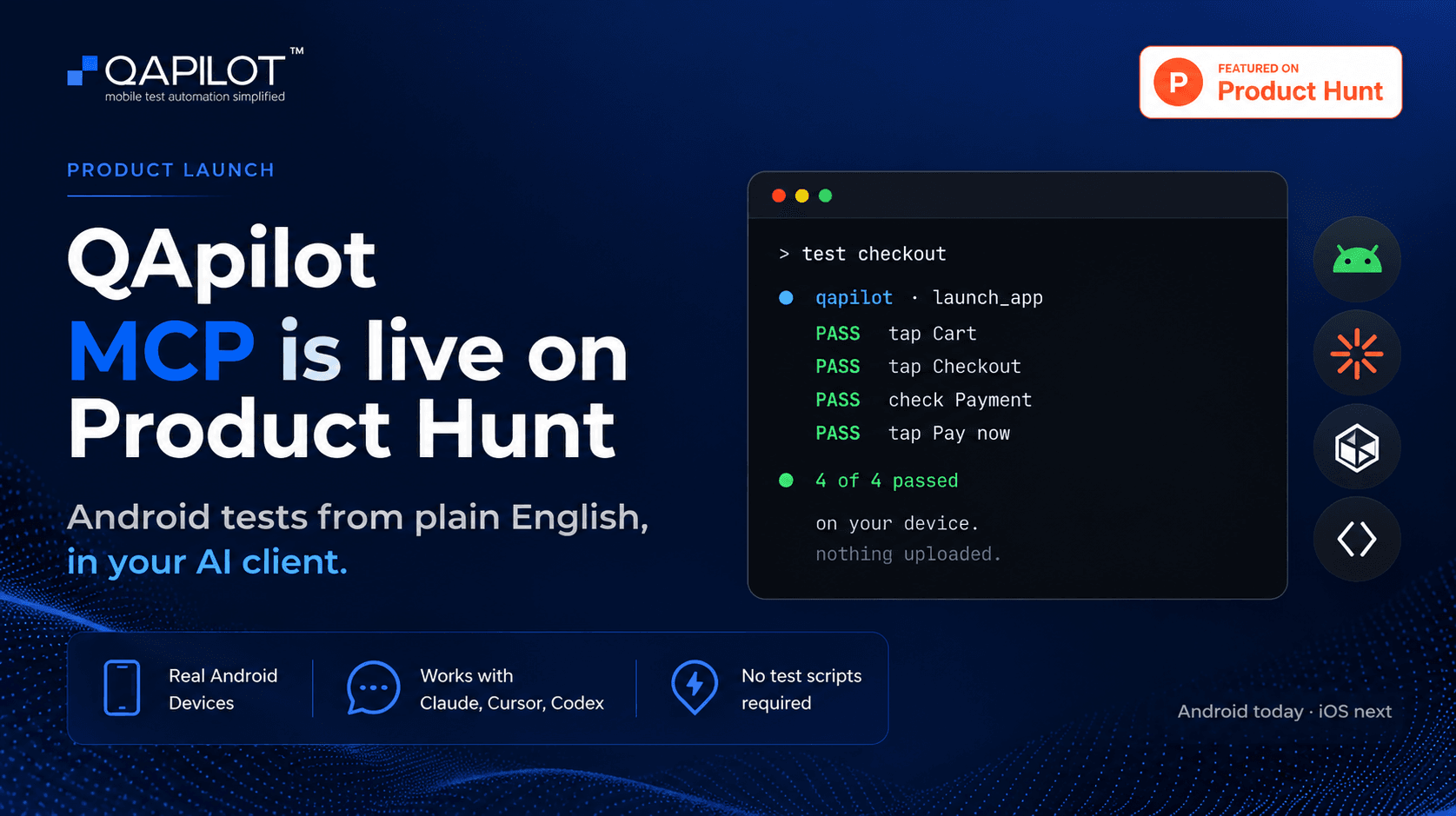
QApilot Launches Android MCP on Product Hunt
QApilot MCP is now live on Product Hunt, letting developers use Claude, Cursor, or Codex to drive Android apps and run test flows from plain-English instructions.
Read More
BFSI Is Pushing the QA Industry Forward
BFSI is not just adopting the next generation of quality engineering. Its requirements are actively helping define what that next generation needs to look like.
Read More
QApilot Shares AI-Native Mobile Testing Insights with Naveen Automation Labs
QApilot Co-founder Aditya Challa joined Naveen Khunteta for a live webinar exploring AI-native mobile testing, autonomous exploration, Flutter testing, and release-ready quality signals. The session featured live product demonstrations and practical insights into modern mobile QA workflows.
Read More